
Why do we play music?
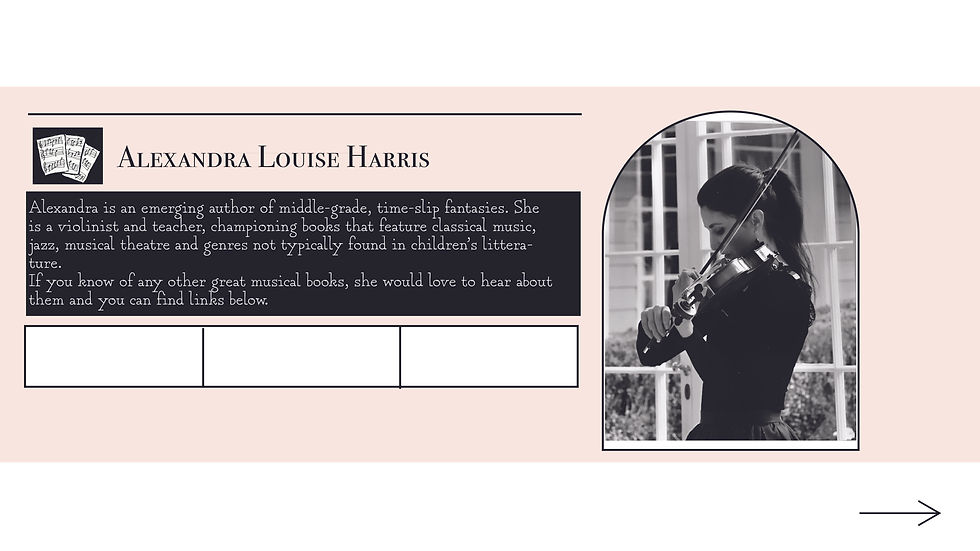
- Alexandra Louise Harris

- Sep 1, 2025
- 3 min read
Transcript from the first episode of Musical Wonders of the Universe

Have you ever thought there’s something magical about music? I’ve often wondered if all those frequencies and vibrations we send out into the universe have some positive impact on our energy. People have been playing for centuries, coming together to perform or celebrate, but have you ever wondered why? If you’re anything like me, you have a feeling in your stomach that it’s important. That humans are here to create sounds, pictures, movement and stories and that somehow, they make the world a better place.
Welcome to Musical wonders of the Universe. My name is Alexandra Louise Harris. I’m a violinist, a teacher and the creator of middle-grade stories featuring classical music. Each week I’ll take you behind-the-scenes and deep dive into the questions that inspire my writing. I’m not a scientist, but I have an inkling there are musical wonders of the universe out there to explore… For instance, is it shaped like a dodecahedron? What is the golden ratio and what does that have to do with music? Well today, we’re diving into why humans play it.

Now I don’t want to offend Ferdinand here, but playing the violin isn’t easy. When most of us begin learning, the sounds we make aren’t all that pleasant to listen to, and even now, after playing for around thirty-five years, my practicing still makes my husband dive for his noise cancelling headphones. Still, I can’t help playing. I’d feel that something was missing from my life if I didn’t. But when did music first become a thing?
It’s hard to define, but bone flutes have been discovered dating as far back 30,000 - 90,000 years. Percussion instruments too, The first trace of a bow is thought to have been from a painting of a shaman from around 15,000 BCE in the Cave of the Trois-Frères.
Written music as part of religion or poetry are amongst the earliest texts to have survived. The oldest forms of musical notation have been discovered on tablets or Papyrus, and the Hurrian Songs from Ugarit Syria are said to be the oldest surviving forms of musical notation.

However, it took a long time for music notation to become what we know it as today.
The surviving music from Medieval Europe was closely related to the church and looked something like this.

In the Byzantine era, traces of music used for secular reasons—celebrations, theatre and dance—were found along with the sacred, or religious texts. During the renaissance, the printing press was invented and styles like the Venetian school emerged. By the time the baroque period came about in around 1600 - 1750, composers like Vivaldi were writing their compositions in styles we can read today…Well, almost…

Even so, we are still playing a lot of his music. People to this day perform Palestrina’s songs Then, there is music that has been passed down from generation to generation through aural traditions.
So why do you think it has survived? What is so great about music that we continue to play it?
Well, in the next ten episodes, we’re going to explore some musical wonders of the universe that I think might have something to do with it. Old instruments, nature’s songs, the effect of music on the human brain, mythology, music as therapy, bizarre sounds, celebrations, memories and time travel.

Yep. There’s another reason you might wish to take up playing the violin. Each week, along with musical wonders, I’ll also share with you an animated music video. The one you are about to see is the trailer from Signore Maggiorino and the Eight Rarest Sounds featuring Vivaldi’s Concerto for Four Violins.

The eBook is free for you to read by following the link and these episodes will appear every Sunday night here in Australia.
Next time we’ll be discussing wood—the oldest and most expensive violins and what makes them so valuable. I hope you can join me and until then, happy music making.
Thank you so much for watching and listening.
If you have any thoughts or comments please email me at alexnadra@alexandralouiseharris.com. I love to hear from you and if you have a moment to subscribe, comment or like this episode, that would be most appreciated.
Sign up to Alexandra's seasonal newsletter for more musical fun.
Comments